
The fibre laser has become the default cutting machine in most sheet metal shops — but the specification conversation is still dominated by a single number: laser power. Power matters, and it is also the easiest specification to over-buy, because cutting thickness and cutting speed at thickness are not the same requirement, and neither of them is decided by the resonator alone.
This guide sets out the decisions in the order that keeps the machine matched to the work.
Step 1 — Start from thickness and required speed
Manufacturers publish a maximum cutting thickness per power level. Those figures are real, but they describe the point at which the machine can still cut — not the point at which it cuts economically. The relevant question is: at my working thickness, what feed rate do I get, and is that fast enough to matter?
As an indicative starting point, in mild steel with oxygen assist:
| Resonator power | Comfortable production range (mild steel) | Practical maximum (mild steel) | Typical stainless range |
|---|---|---|---|
| 1.5 kW | up to 3 mm | 4–6 mm | up to 3 mm |
| 3 kW | 3–6 mm | 8–10 mm | up to 5 mm |
| 6 kW | 6–12 mm | 16–20 mm | up to 10 mm |
| 12 kW | 12–20 mm | 25 mm and above | up to 16 mm |
Treat these as orientation, not specification — real capability depends on gas, nozzle, focus and material quality. The point of the table is the shape of the trade-off: below roughly 6 mm, higher power buys speed; above that, it buys the ability to cut at all. If 90% of your work is 2 mm enclosures, a 12 kW machine is a capital cost with no return.
The exception worth knowing
High power is not only about thick plate. On thin material, a high-power source with the right cutting parameters can raise feed rates enough to remove a bottleneck — but only if your loading and unloading can keep up. A laser that cuts faster than your operator can load it is not a faster shop.
Step 2 — Choose the assist gas deliberately
Assist gas determines cut edge quality, speed and a large share of your running cost.
| Gas | Best for | Edge result | Relative cost |
|---|---|---|---|
| Oxygen (O₂) | Mild steel, thicker sections | Oxidised edge, generally weldable after cleaning | Low |
| Nitrogen (N₂) | Stainless, aluminium, appearance-critical parts | Clean, oxide-free edge | High |
| Compressed air | Thin mild steel, non-critical parts | Acceptable, slight oxidation | Lowest |
If stainless or visible aluminium work is a routine part of your mix, budget for a nitrogen supply — either a dewar or an on-site generator — at the same time as the machine, not six months later. Nitrogen cost per hour is the line item that most often surprises first-time laser owners.
Step 3 — Specify the cutting head, not just the source
Two machines with identical resonators perform differently because of the head. What to check:
- Automatic focus control. Lets the focus position be tuned per material and thickness. On a machine without it, every material change becomes a manual setup.
- Nozzle type and diameter range. Single, double and speciality nozzles each suit different gases and thicknesses. Confirm the range available, not just the one supplied.
- Capacitive height sensing. Keeps the stand-off constant across a warped sheet. This is what separates consistent cuts on thin material from intermittent ones.
- Protective lens and window design. Consumable protection that is quick to change keeps the machine cutting; a fiddly assembly turns a five-minute job into a shutdown.
Step 4 — Look hard at the bed and the frame
A laser’s accuracy over its life depends on the structure, not the specifications sheet. Ask about the bed’s construction and how the machine handles thermal growth: as the source runs, the frame warms and geometry drifts. Machines that compensate for this hold their tolerances over a shift; those that do not require warm-up procedures and periodic re-calibration.
The cutting bed itself is a wear item. Check the exchange-table arrangement — pallet changing is what keeps the laser cutting while parts are unloaded — and confirm the slat replacement routine, because slat maintenance is a recurring cost that new buyers rarely plan for.
Step 5 — Work out the true running cost
Purchase price is the smaller part of laser ownership. Build a per-hour figure that includes:
- Resonator and chiller power consumption (this is the dominant electrical load).
- Assist gas consumption per hour at your typical material mix.
- Consumables: nozzles, protective lenses, windows, slats.
- Service plan and spare-part lead times.
- Floor space, extraction and any gas supply installation.
Run this against your hourly cutting requirement. A cheaper machine with high gas consumption and short consumable life can be the more expensive choice within two years.
Step 6 — Check how the laser hands off to the next process
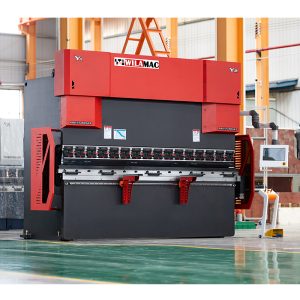
A laser produces blanks; those blanks then need forming. The cut quality — edge taper, dross, heat-affected zone — determines how the blanks behave when they reach the press brake, and a clean, oxide-free edge bends more predictably than an oxidised one. If your parts require clean edges before forming, that pushes the gas decision toward nitrogen, which in turn changes the running cost above.
For shops without a laser, the alternative is a shearing machine for straight cuts plus manual or turret punching for profiles — cheaper to buy, and limited to straight-line geometry. The laser earns its cost when you need profiles, cut-outs and nesting at volume.
Buying checklist
- Your working thickness range, and the feed rate you need at that thickness.
- Maximum thickness you genuinely expect, with margin for future work.
- Material mix — the share of stainless and aluminium drives the resonator size and the gas system.
- Assist gas plan and supply installation, costed up front.
- Cutting head features: auto focus, height sensing, nozzle range.
- Bed and frame construction, thermal behaviour, pallet change arrangement.
- Running cost per hour, including gas and consumables.
- Service coverage, response time and consumable lead times.
- Extraction, floor space and power supply requirements.
FAQ
Is more laser power always better?
No. Power buys speed on thin material and capability on thick material. If you do not work at either end, the extra power is idle capital and higher running cost.
Can I cut stainless with oxygen?
You can cut it, but the oxidised edge is usually unacceptable for stainless parts and requires post-processing. Nitrogen is the correct choice for stainless when edge quality matters.
How much does assist gas really cost?
For nitrogen cutting of stainless it is typically a significant share of the hourly running cost — often the largest consumable line. Model it against your actual material mix before choosing the machine’s power level.
WILAMAC supplies sheet metal processing equipment and tooling, and builds forming solutions that match the blanks your cutting process produces. Tell us your material mix and thickness range, and we will confirm the cutting method and the downstream forming configuration that fits.


