
Automation projects fail for a predictable reason: they are bought as equipment rather than managed as a process change. A robot bending cell bolted onto a shop that has not measured its own bottleneck usually just moves the queue somewhere else.
This guide sets out a sequence that keeps the investment tied to a measurable return, and shows where the money is actually recovered.
Step 1 — Measure before you automate
Automation pays back by removing variability and handling time, not by making a machine run faster. So the first step is to find out which of the two is costing you.
For each process, record:
- Machine time: actual cutting or forming time per part.
- Setup time: time between the last good part of the previous job and the first good part of the next.
- Handling time: loading, unloading, stacking, transferring, waiting for an operator.
- Queue time: how long a batch sits before anyone touches it.
Then compare the results. In most job shops the surprise is that machine time is a minority of total throughput time, and setup plus handling dominate. If that is what you find, the first investment is often not a robot — it is quick-change tooling, a pallet system, or simply a better job-release discipline.
| What the measurement shows | What actually fixes it | Relative cost |
|---|---|---|
| Setup dominates | Quick clamping, segmented tooling, program storage, standardised fixtures | Low |
| Handling dominates | Loading aids, sheet lifters, pallet change, conveyor off-load | Medium |
| Machine time dominates and machine is oversubscribed | Additional machine capacity, higher-power process | High |
| Queue and waiting dominate | Scheduling and job-release discipline, batch sizing | Very low |
| Quality rejects dominate | Process control, tooling condition, incoming blank consistency | Low to medium |
Step 2 — Choose the level of automation honestly
Automation is a ladder, and each rung depends on the one below it being stable. Skipping rungs is where projects lose money.
| Level | What it is | Suits | Prerequisite |
|---|---|---|---|
| 1 — Standalone automation | One machine with automatic positioning, program recall, gauging | High-mix, low-volume job shop | Repeatable part programs and tooling discipline |
| 2 — Cell | Two or more machines linked by a robot or transfer, e.g. brake + robot + stacker | Repeat production of a part family | Consistent blanks and a stable part family |
| 3 — Line | Cutting, forming and handling integrated with a single control flow | High-volume, low-variety production | Stable demand, engineered process, maintenance capability |
| 4 — Purpose-built machine | A machine designed for one product and one process from the start | Single high-volume product | Long product life and volume certainty |
Level 4 is where dedicated production equipment sits — machines built around a single product, like our insulation pin making machine, which runs a fixed process at a fixed rate rather than being reconfigured for each job. That approach delivers the highest throughput per operator, and it is only rational when the product’s volume is certain and stable.
Step 3 — Design the bending cell around the part family
The most common automation project in sheet metal is a robotic press brake cell. Its economics depend on three things:
- Part family consistency. A cell needs a stable family — similar sizes, similar bend sequences, similar material. A cell asked to handle wildly different parts will spend its time being reprogrammed.
- Gripper and end-effector design. Holding a part through multiple bends, including bends that close over the gripper, is the hardest engineering problem in the cell. It has to be solved at design stage, not on site.
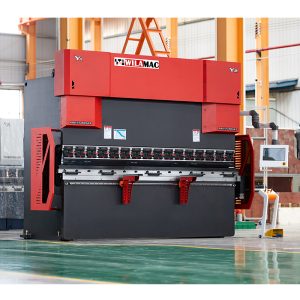
- Tooling strategy. Automatic tool changing or a fixed tool setup determines whether the cell can run unattended. Without it, an operator is still needed at every job change — see our electro-hydraulic press brake for the axis and controller features that make a brake suitable as a cell’s core machine.
Step 4 — Do the capacity arithmetic before the ROI
Automation changes the ratio of attended to unattended hours. Work it through on your own numbers, using an illustrative example:
| Metric | Manual | Automated cell |
|---|---|---|
| Parts per hour (attended) | 40 | 60 |
| Attended hours per shift | 8 | 2 (setup and monitoring) |
| Unattended hours per shift | 0 | 6 |
| Parts per shift | 320 | 480 |
| Operator shifts required for 480 parts | 1.5 | 1.0 |
The gain is not that the cell is faster — it is that a larger share of the output needs no operator. That is what converts labour cost into capacity. Run the same table with your real parts-per-hour and your real hourly labour cost; if the difference does not cover the cell’s capital and maintenance cost within your payback horizon, the cell is not yet justified.
Add the costs that get forgotten
Budget for integration engineering, end-effector tooling, safety guarding and light curtains, floor space and layout changes, power and air supply, operator retraining, and a maintenance contract. On many projects these together come to a significant fraction of the machine price, and they are the reason a project that looked viable on equipment cost alone turns out marginal.
Step 5 — Agree acceptance criteria and support before you order
Automation is delivered as a system, and acceptance should be defined as a system: parts per hour at the agreed quality level, over an agreed run duration, with an agreed reject rate, demonstrated on your material and your part. Anything less turns into a commissioning argument.
Also settle these before signing:
- Who supplies and programmes the robot, and who owns the programs afterwards.
- Training: how many operators, how many days, and on which part of the system.
- Spare parts list and lead times for the components you cannot run without.
- Remote diagnostics — whether the supplier can support the line without a site visit.
- What happens to throughput when one station fails; a cell without a defined failure mode can stop the whole shop.
Common pitfalls
- Automating an unstable process. Robots repeat exactly what they are told, including a wrong setup. Stabilise first.
- Ignoring incoming material variation. If blank size or thickness varies, the cell will reject parts the manual process used to tolerate.
- Designing for today’s part only. A cell with no allowance for a second part family is a single-purpose asset.
- No maintenance plan. Unattended running concentrates wear into fewer hours; without planned maintenance the cell’s availability falls.
- Underestimating the gripper. The end effector is usually the hardest and most underestimated element of the project.
Buying checklist
- Measured breakdown of machine, setup, handling and queue time.
- The specific bottleneck the project is meant to remove.
- Part family definition and annual volume per family.
- Level of automation chosen, with the prerequisite rung already in place.
- End-effector design validated against the full bend sequence.
- Tooling strategy: fixed setup or automatic changing.
- Capacity arithmetic on your own numbers, plus forgotten integration costs.
- Acceptance criteria stated as parts per hour at quality over a defined run.
- Training, spares, diagnostics and single-station failure behaviour.
FAQ
Is a robot cell worth it for a job shop with high product variety?
Usually not at first. High-variety work benefits more from reducing setup time — quick clamping, program storage, standardised tooling — because that cost is recovered on every job rather than only on the automated family.
How long does a typical cell take to pay back?
It depends entirely on your labour cost and the share of output that becomes unattended. Build the arithmetic from your own parts-per-hour and hourly cost; a supplier quoting a payback period without your numbers is estimating, not calculating.
Can I automate the press brake without a robot?
Yes. Automatic tool changing, program recall, sheet followers and crowning compensation remove a large part of the manual time and are far cheaper than a full cell. Many shops should exhaust these before considering robots.
WILAMAC builds sheet metal processing equipment and dedicated production machines, and works with customers on production line and automation configurations around a defined part family. Share your volume, part family and current cycle time, and we will tell you which rung of the ladder actually pays for itself in your shop.


