
A press brake is the most consequential machine purchase in most sheet metal shops — it sets the limits on what you can bend, how fast you can bend it, and how much of the work has to be farmed out. Yet most buyers start the conversation at the wrong end, asking about brand or price before they have fixed the three numbers that actually determine the machine: tonnage, bending length and throat depth.
This guide walks through the selection sequence in the order that prevents expensive mistakes, and shows where the trade-offs actually sit between a basic two-axis machine and a fully specified multi-axis CNC press brake.
Step 1 — Calculate the tonnage you actually need
Tonnage is not a function of the part’s size. It is a function of the length of the bend, the material, and the die opening you intend to use. The working formula is:
Required tonnage = (1.42 × material tensile strength × sheet thickness² × bend length) ÷ (1000 × die V-opening)
Two things trip buyers up here. First, the thickness term is squared, so a small increase in thickness has a large effect on tonnage. Second, a narrower V-opening raises tonnage sharply — which matters because most shops pick a narrower die than the material thickness strictly requires, in order to get a tighter inside radius.
| Material | Tensile strength (approx.) | Relative tonnage factor |
|---|---|---|
| Mild steel | 400–450 MPa | 1.0 (reference) |
| Cold-rolled steel | 450–500 MPa | 1.05–1.15 |
| Stainless steel (304) | 600–700 MPa | 1.4–1.6 |
| Aluminium (5052) | 230–250 MPa | 0.55–0.6 |
| High-tensile / wear plate | 700–900 MPa | 1.6–2.0 |
Size the machine at roughly 1.2–1.3× your calculated requirement, not exactly at it. The margin absorbs the day you switch to stainless, and it keeps you off the machine’s rated limit, which is where ram deflection and uneven bends start to appear.
A common sizing mistake
Shops routinely buy tonnage for the thickest part they make today, then discover the machine cannot handle a full-length bend in that thickness because the tonnage chart is rated per metre, not per machine. Always check: tonnage at your maximum bending length, not tonnage at the middle of the bed.
Step 2 — Fix the bending length and throat depth
Bending length is straightforward — buy for the longest part you expect, plus a little. The trap is throat depth, which decides how deep a box or return flange you can form. A machine with generous tonnage but a shallow throat will refuse the very parts you bought it for.
- Standard boxes and pans: 300–400 mm throat is usually sufficient.
- Deep cabinets, ducting, enclosures: 400–500 mm or more.
- Long returns on wide panels: check that the upper beam, not just the throat, clears the flange during the stroke.
Step 3 — Decide how many axes you really need
Axis count is where budget is most often misallocated. Every axis buys a specific capability, and paying for an axis you cannot use is as costly as omitting one you need.
| Axis | What it controls | Buy it when |
|---|---|---|
| Y1 / Y2 | Independent left and right ram position | Always — this is what makes the machine a CNC press brake rather than a manual one |
| X | Back gauge depth (position of the stop) | Always for production work; it is the single biggest time saving |
| R | Back gauge height | Multiple part families with different flange heights on one setup |
| Z1 / Z2 | Lateral position of each back gauge finger | Bending parts with cut-outs, or running two setups side by side on one bed |
| Additional (crowning, sheet follower) | Compensation for ram deflection, support for large panels | Long bends in thick material, or large thin panels that sag |
A practical rule: 4+1 axes (Y1, Y2, X, R plus crowning) covers the large majority of general fabrication work. Move up to 6 axes or more when you are running families of parts with varying flange geometry, or when setup time — not machine time — is your bottleneck.
Step 4 — Choose the drive and control system
For most shops the meaningful choice is between a torsion bar machine and an electro-hydraulic synchronised machine. The torsion bar design mechanically links the two ends of the ram; it is simpler and cheaper, but the ram position is set by the linkage rather than measured, so accuracy depends on the mechanism staying in adjustment. Electro-hydraulic synchronised machines measure and control each side of the ram independently, which holds accuracy over time and is what you want if you are holding tolerances on repeat production.
On the control side, what matters is not the badge but three things: the number of axes it can drive, whether it stores and recalls part programs with bend sequences, and whether the bending-angle calculation takes material and tooling into account. A controller that cannot store a program turns every repeat job back into a setup job.
Step 5 — Match the tooling interface before you sign
The tooling interface is the specification that most often forces a machine to be rebuilt or a tool set to be remade. European-style self-seating clamping, American-style and Amada-style systems are not interchangeable, and the punch shank profile is machine-specific.
Decide early whether you will standardise on a quick-clamping system. It costs more up front and repays it in setup time on every job change. If you are buying tooling alongside the machine, it is worth specifying segmented punches and a range of V-openings up front — see our press brake punch and die tooling for how segmented sets are specified, and our hinge curling punch and die for an example of a speciality forming application.
Step 6 — Check the whole process, not just the brake
A press brake does not work alone. If the blanks arriving at the brake are inconsistent, no amount of ram accuracy will save the finished part — sheared edges that are not square show up as bend-line variation. If your upstream cutting is manual or inconsistent, budget for a shearing machine or a laser before you spend the extra on axes you cannot yet exploit.
The specification that suits a general fabrication shop
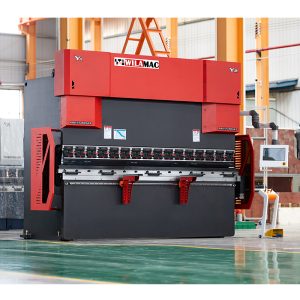
A machine in the 100 t / 3200 mm class with independent Y1/Y2, X and R axes, crowning compensation and a controller with program storage covers most job-shop work: mild steel up to around 6 mm over 3.2 m, shorter bends in thicker plate, and the full range of box and pan work within the throat. That is the configuration behind our WE67K 100T 3200 mm electro-hydraulic press brake — a useful reference point for comparing tonnage, axis count and controller against your own part list.
Buying checklist
- Your thickest and your longest bend, stated separately — they rarely need the same machine.
- Required tonnage recalculated at maximum bending length, plus a 20–30% margin.
- Deepest box or flange you will form, converted into a throat depth requirement.
- The material range you will realistically run in the next three years, not just today.
- Axis count justified part-by-part, not by the brochure.
- Tooling interface, clamping system and whether the tooling is included or extra.
- Controller: program storage, axis count, angle calculation.
- Installation, training, warranty terms and spare-part lead time.
FAQ
Can I bend thicker material on a smaller machine by using a wider die?
Yes, and this is a legitimate lever — a wider V-opening reduces required tonnage. The trade-off is a larger inside radius and less control over the finished angle, which is acceptable for structural work and usually not for precision parts.
Is a two-axis machine ever the right answer?
For one-off work and simple brackets, yes. The cost of X and R axes is recovered quickly once you are running repeat jobs, so the decision should be driven by your job mix, not by the machine price.
How do I compare two machines with the same tonnage?
Compare them at the same die opening and the same bending length, then compare throat depth, axis count, controller features and the tooling interface. Tonnage alone tells you very little about capability.
WILAMAC builds CNC press brakes and custom press brake tooling for sheet metal fabricators, including the WE67K range of electro-hydraulic machines and 42CrMo tooling manufactured to drawing. If you share your part list — material, thickness and longest bend — we can confirm the tonnage and axis configuration you actually need.


