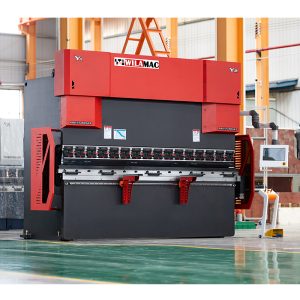

Buying a press brake is not a matter of picking the largest tonnage you can afford. It is a matter of matching three things to each other: the parts you actually run, the tooling you intend to use, and the level of control your operators can use productively. Get those three aligned and the machine will pay for itself. Get them out of alignment and you will own an expensive bottleneck.
This guide walks through the decisions in the order they should be made.
Start with the part, not the machine
Before looking at any machine, list the parts you bend today and the parts you expect to win. For each one, record:
- Material and grade — mild steel, stainless, aluminium, and the specific grade where it matters
- Thickness range — not the average, the extremes
- Maximum bend length — the longest single bend you will make
- Box depth and flange height — this drives the throat depth and the height of your punch
- Bend radius requirements — and whether they are functional or cosmetic
- Annual volume and batch size — a shop running long runs of one part has different needs from a job shop
This list is the specification. Everything else is a consequence of it. A machine chosen from a part list will fit. A machine chosen from a brochure will be either oversized and underused, or bought twice.
Tonnage: size it from the bend, not the budget
Bending force depends on the material, its tensile strength, the thickness, the length of the bend, and the width of the die opening (the V). Change any one of those and the required force changes with it.
Three practical consequences follow:
- A wider V reduces the force needed, but increases the inside radius. If your drawing calls for a tight radius, you cannot simply open up the die to make the tonnage work.
- Stainless and other high-tensile materials demand more force than mild steel at the same thickness and length. A machine that is comfortable in mild steel may be marginal in stainless.
- Force is not the only limit — tooling has its own limit. Every punch and die has a maximum permissible load per unit length. A machine capable of more tonnage than the tooling can take is not a more capable machine; it is a machine waiting to damage a die.
For these reasons, tonnage should be calculated against your actual worst-case part and then checked against the tooling you plan to run. Ask the supplier to show the calculation, not just a number.
Control type: buy the control your work needs
Press brake controls are usually described by the number of controlled axes. The useful question is not “how many axes” but “which of my problems does each axis solve”.
| Configuration | What it controls | Typically suits |
|---|---|---|
| NC / basic CNC | Bend depth and backgauge position | Simple, repetitive, single-bend parts |
| CNC with multi-axis backgauge | Additional backgauge axes for height, and often a second stop | Parts with several bends from different references, box and pan work |
| CNC with controlled crowning | Automatic compensation for ram deflection | Long bends where angle consistency across the part matters |
| Higher-axis CNC | Sheet following, bend angle measurement and correction | Demanding work where first-part accuracy and consistency are critical |
Two rules of thumb are worth holding on to. First, more axes only pay back if someone programmes and uses them — an unused axis is capital sitting idle. Second, the value of automatic angle correction rises sharply with part length and with the cost of a scrapped part. If you scrap a long, expensive part once, the case for better control usually makes itself.
Crowning: the difference between a bend and a consistent bend
Under load, the ram and bed of a press brake deflect. The result is a bend that is correct in the middle and open at both ends — or the reverse, depending on the setup. Crowning is the correction for that deflection.
There are three broad approaches: shimming the die by hand, a manual or motorised wedge system, and a CNC-controlled crowning system that compensates automatically as the load changes. The trade-off is setup time and operator dependence. On short parts, the difference is small. On long parts, or where several operators share the machine, automatic crowning is usually what keeps the scrap rate down.
Tooling interface and clamping
It is easy to treat tooling as a separate purchase. In practice, the machine and the tooling are one system, and the interface between them should be decided together.
Things worth settling early:
- Tooling system style — punches and dies are not interchangeable across systems, and the style you commit to determines what you can buy later
- Clamping method — manual, mechanical quick-clamp, or hydraulic/pneumatic
- Segment handling — whether you need to load partial-width segments often, which argues for faster clamping
- Whether you will also run custom or special tooling — if so, confirm the machine can accept it before you order
A machine with fast clamping and a well-supported tooling system will out-produce a nominally more powerful machine whose tooling changes take twenty minutes.
Frame, hydraulics and serviceability
Ask about the structure of the frame (how it is built and how it is stress-relieved), the hydraulic system and its component suppliers, and — critically — what happens after the machine lands.
- Who supports the machine in your country, and how quickly?
- What is the spare parts lead time for wear items?
- Is operator and maintenance training included?
- Are electrical drawings and a maintenance manual provided?
A press brake is a ten-year asset. Service access is part of the specification, not an afterthought.
Safety: match the machine to your market
Safety requirements vary by destination market and by how the machine will be used. When specifying, confirm with your supplier that the machine is configured for the safety regime that applies where it will be installed, and that the guarding and control arrangements suit your production method. This is not an area to leave to assumption, and it is not an area where the cheapest configuration is the right one.
What to send a supplier for an accurate quote
If you send a supplier the following, you will get a quote that means something:
- A representative part drawing or drawing set, with the number of bends marked
- Material grade and thickness range
- Maximum bend length and box depth
- Required bend radius and tolerance, and whether the angle is critical
- Annual volume and typical batch size
- Tooling you already own, if any, and whether it must be reused
- Destination country and site power supply
- Any automation expectations (sheet handling, robot interface, multi-machine line)
With those eight items, a supplier can size the machine, propose tooling, and give you a configuration you can compare like for like against other quotes. Without them, every quote you receive will be for a different machine.
Frequently asked questions
Can I buy a press brake with more tonnage and simply run lighter work? You can, but you should check the tooling and the control first. Extra tonnage does not improve accuracy, and it can encourage settings that damage tooling. Better to size the machine to your parts and spend the difference on control and tooling.
Is CNC always better than NC? Not automatically. If your work is simple and repetitive, a well-chosen NC machine with good tooling can be the more profitable purchase. CNC earns its cost on variety, on multi-bend parts, and on angle-critical work.
How do I decide between a standard and a custom top tool? Start with the drawings. If a standard punch profile will produce the required radius and can reach the bends without collision, standard tooling is faster and cheaper. Custom tooling is justified when the part geometry cannot be formed otherwise — for example when a flange or return interferes with a standard punch.
Do we need automatic crowning on a shorter machine? The shorter the bend, the smaller the deflection, so the benefit is smaller. Judge it against your longest and most tolerance-sensitive part rather than against the machine’s nominal length.
Next step
If you send us the eight items listed above, we will come back with a proposed configuration, the matching tooling, and the points where your part mix creates a constraint worth discussing. That conversation usually saves more money than any negotiation on price.
Request a press brake configuration proposal →
Browse our press brake range: Press Brakes →


