



Louvers are one of the few sheet metal features that a standard punch and die set cannot produce. They need a dedicated louver punch die, and the tooling has to be built around the louver geometry you want — not selected from a catalogue. This guide covers what a louver punch die actually is, which parameters decide whether it works, and what to send a supplier so the tooling arrives ready to run.
Why louver forming is not ordinary bending
A normal bend forms one angle over a straight line. A louver is a raised, angled opening punched and formed in a single stroke: the material is sheared on three sides and lifted on the fourth. The result is a vent or airflow slot that stays rigid, keeps its opening clear, and adds stiffness to the panel around it.
That difference drives the tooling. A louver punch has to cut and form at the same time, which means the punch tip geometry, the die opening and the stripper all have to be matched to the louver dimensions rather than chosen from a standard tonnage chart.
What is inside a louver punch die
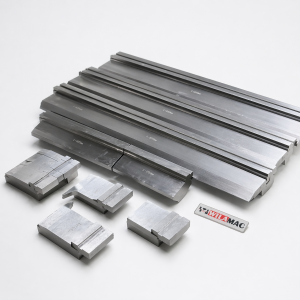
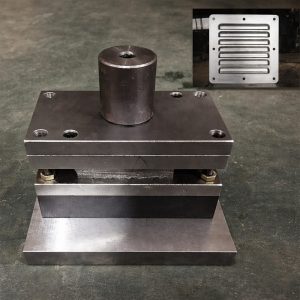
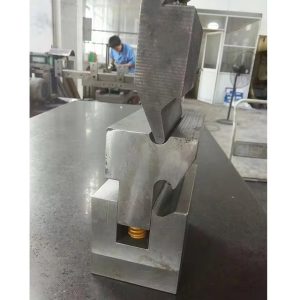
A typical louver tooling assembly contains four functional parts:
- Louver punch — carries the cutting and forming edge. Its profile determines louver height and the rake angle of the opening.
- Louver die — the female counterpart, with an opening sized so the material can be pushed through without tearing at the louver ends.
- Stripper / pressure pad — holds the sheet flat around the louver during the stroke. Without it, the panel lifts and the louver comes out with a distorted surround.
- Tool holder or shank — the interface to the press brake. This is where most compatibility problems appear.
For multi-louver panels — ventilation grilles, server rack doors, louvered covers — the punch is built as a gang tool so that all louvers in one row are formed in a single hit.
Parameters that decide whether the tooling works
Before a louver punch die can be quoted accurately, these values need to be fixed:
1. Louver pitch and count
Pitch is the centre-to-centre distance between adjacent louvers. Count and pitch together define the tool length and whether the row fits the press brake bed in one stroke.
2. Louver height and opening angle
Louver height is measured from the sheet surface to the highest point of the formed louver. Opening angle controls how much air the louver passes. Both are cut into the punch profile, so they are fixed at the tooling design stage — they cannot be adjusted later on the machine.
3. Material and thickness
Louver forming is harder on tooling than plain bending because the material is sheared and stretched at the same time. Thin cold-rolled steel and stainless steel behave very differently: stainless work-hardens at the shear line, so the punch edge needs a different geometry and a higher hardness to survive.
4. Press brake tonnage and bed length
Required tonnage depends on the total shear length of the louver openings, not on the panel size. Under-specifying tonnage is the most common cause of incomplete louvers; over-specifying it is the most common cause of a cracked punch.
5. Clamping system and machine interface
European-style tooling uses a self-seating, safety-click interface, while American-style and Amada-style systems use different shank profiles and clamping methods. A louver punch die must be built for the specific holder on your machine — this is the single item that most often forces a tool to be remade.
Tooling material and heat treatment
Most production louver punches and dies are made from 42CrMo alloy steel — the same base material used across our press brake punch and die tooling — chosen for a balance of toughness and hardenability at the section thicknesses louver punches require. Heat treatment is typically to a working hardness in the region of 45–52 HRC, with the exact figure set by the material being formed:
- Mild and cold-rolled steel: lower hardness is acceptable and reduces the risk of edge chipping.
- Stainless steel and high-tensile sheet: higher hardness and, in many cases, a surface treatment such as nitriding or a wear-resistant coating to slow edge wear.
- Aluminium: polished, uncoated tooling usually performs better, because aluminium tends to gall on coated surfaces.
Ask for the hardness specification and the heat treatment record with the quotation. It is the clearest signal of whether a supplier is building tooling or reselling it.
Common failure modes and how to avoid them
| Symptom | Usual cause | Corrective action |
|---|---|---|
| Louvers incomplete or half-formed | Insufficient tonnage for the total shear length | Recalculate tonnage against shear length, not panel size |
| Punch tip cracking | Excessively hard punch in a thin-material application, or tonnage far above requirement | Reduce hardness, review tonnage setting |
| Distorted panel around the louver | Missing or worn stripper / pressure pad | Replace stripper, check pad preload |
| Burrs on the louver ends | Die opening too tight, or worn punch corners | Re-cut die opening, radius the punch corners |
| Louver height drifting along the row | Uneven tool loading or bed deflection | Check ram parallelism and tool shimming |
A practical buying checklist
Sending these six items gets a usable quotation instead of a request for clarification:
- Panel drawing with louver pitch, count, height and opening angle
- Sheet material and thickness
- Press brake make and model, plus the clamping system in use
- Required tool length and whether one row fits in a single stroke
- Annual or per-order volume, so heat treatment and coating can be matched to tool life
- Whether you need a single louver tool or a gang tool for the full row
Tooling is quoted in working days, not days, and the design freeze happens on the drawing — so it is worth getting the louver dimensions right before the drawing is signed off.
FAQ
Can I form louvers with a standard press brake punch and die?
No. Standard tooling forms a single bend. A louver needs shearing on three sides and a formed opening, which requires a dedicated louver punch die.
How many louvers can be formed in one stroke?
As many as fit the tool length and available tonnage. Multi-louver work is normally done with a gang tool so that a full row is formed in one hit, which is faster and more consistent than forming louvers individually.
What hardness should louver tooling be?
Typically in the region of 45–52 HRC, adjusted for the sheet material. The supplier should state the figure and the heat treatment process in the quotation.
Does louver tooling fit any press brake?
The tooling is machine-interface specific. The louver geometry is universal, but the shank and clamping profile must match your machine’s holder.
WILAMAC supplies custom press brake tooling, including louver punch dies, hinge forming tools and standard punch and matrix die sets, built to drawing with 42CrMo steel and controlled heat treatment.
Related Products
- Custom Louver Punch Die for Press Brake — 42CrMo Matched Punch & Die Set — 42CrMo louver punch die set
- Press Brake Hemming Die — 42CrMo Mirror Polished Matched Set — hemming dies for folded edges
- Precision Press Brake Hinge Curling Punch and Die for Door Hinges — hinge and curling profiles


