
Why spares are a production decision, not a purchasing one
A press brake that is waiting for a part is not a machine, it is floor space. The cost
of a worn backgauge finger or a leaking seal is never the price of the component — it
is the hours of bending capacity that stop while the part is sourced. For repeat
production this usually exceeds the part cost by an order of magnitude.
What falls into this category
Tooling interfaces and clamping
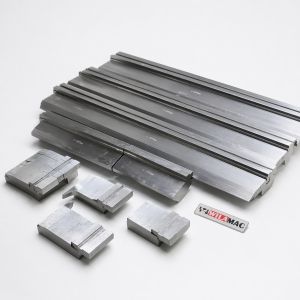
- Punch holders, die holders and intermediate adapters
- Quick-clamp assemblies and clamping levers
- Segmented punch and die holders for box and return bending
- Tooling locating pins, keys and alignment stops
Backgauge and positioning
- Backgauge fingers, finger plates and finger extensions
- Ball screw, linear guide and drive components
- Servo motors and encoder assemblies
- Stop blocks and sheet-support arms
Hydraulic and drive components
- Seal kits, O-rings and hydraulic hoses
- Hydraulic pumps, valves and proportional valves
- Oil filters and reservoir components
- Cylinder seals and guide rings
Crowning systems
- Mechanical crowning wedges and adjustment components
- Hydraulic crowning cylinders and seals
- CNC crowning control components
Control and electrical
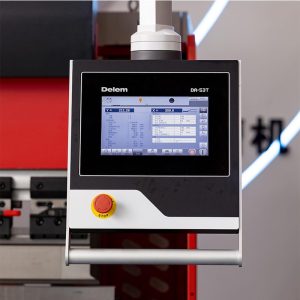
- Control pendants and operator panels
- Foot switches and two-hand control stations
- Sensors, limit switches and relay modules
- Inverter and contactor replacements
Safety equipment
- Light curtains and safety relay modules
- Laser safety systems for bending
- Guarding, side fences and rear guards
How to identify the correct part
Press brake components vary between manufacturers and between generations of the same
model, so a description alone is rarely enough. To identify a part accurately we need:
- Machine model and, if available, the serial number — this is the
fastest route, because it pins down the generation of the machine - The control model, if the part is electrical or relates to the CNC system
- A photo of the part, in place if possible, showing how it mounts
- Dimensions — bore, stroke, thread or mounting hole spacing, whichever applies
- Quantity, and whether you want a single replacement or a stocked spare
Where the original part is obsolete, we will tell you that directly and propose the
closest current equivalent rather than supplying something that nearly fits.
Stocking strategy
Not every part is worth holding on the shelf. A practical approach is to classify by
failure consequence rather than by price:
| Class | Examples | Approach |
|---|---|---|
| Stops production, long lead time | Pumps, servo drives, control modules | Hold one spare on site |
| Stops production, short lead time | Seal kits, hoses, fingers | Hold consumable stock |
| Degrades quality gradually | Backgauge fingers, sheet supports | Replace at inspection |
| Safety-related | Light curtains, safety relays | Never run on a known-faulty unit |
Service and support
Because WILAMAC manufactures press brakes, press brake tooling and accessories, wear
parts and tooling come from the same supplier as the machine — which matters when
you are matching an interface and need both sides to fit.
Request a quote
Send the machine model, a photo of the part and the quantity. We will confirm the
correct component and quote it.
What a production line actually is
A sheet metal production line links individual operations into a continuous flow so
that material moves without being manually re-handled, re-fixtured and re-queued at
every step. The operations themselves are unchanged — cutting, bending, welding,
assembly. What changes is the material handling between them, and that is where both
the cost and the return sit.
Typical line configurations
| Configuration | What it links | Fits when |
|---|---|---|
| Bending cell | Press brake + robot + part magazine | One part family, high repeat volume |
| Cut-to-bend flow | Laser or punch + buffer + press brake | Mixed parts, short cycle, one operator |
| Coil-to-part line | Decoiler + leveller + roll former + shear | Long runs of a single profile |
| Full fabrication line | Blanking + bending + welding + handling | Stable, high-volume product family |
Higher integration is not automatically better. Each added stage removes labour but
also removes flexibility, and the line only pays back on work that repeats.
The three conditions automation actually needs
1. A part family, not a part list
Automation needs parts that share handling geometry, bend sequences and cycle times.
A robot programmed to pick and bend one part does not care how many customers ordered
it — but it cannot switch to a completely different part without setup. Sort your
order book into families before you consider a cell.
2. Volume below the payback threshold is a loss
The real question is not “how much labour will this save” but “how many hours per
week will this cell actually run loaded”. A cell that runs two shifts a day pays back;
the same cell running four hours a day usually does not, and the capital cost sits on
the balance sheet either way.
3. Upstream consistency
Automation amplifies whatever variation reaches it. If blank dimensions vary, a robot
will either mis-grip or mis-load, and a line that stops constantly is worse than a
manual cell. Blanking quality and part consistency must be solved before the
line, not by it.
The costs that get left out of the proposal
- Programming and offline simulation software, plus the engineer to run it
- Part magazines, grippers and end-effectors — often part-specific
- Safety fencing, light curtains and guarding, and the floor space for them
- Compressed air, power and foundation work
- Operator retraining, and the output dip while the line is commissioned
- Ongoing maintenance and spares for the automation, which has a different failure profile from the machine tools
What we need to assess your case
- Part drawings or a representative sample of the part family
- Annual volume and batch size per part
- Current process steps, cycle times and labour content
- Available floor space and layout constraints
- Shift pattern and realistic loaded hours for a new cell
- Existing machines the line would need to integrate with
Service and support
WILAMAC supports line projects from specification through installation,
commissioning, operator training and after-sales service, drawing on the same press
brake, shearing and tooling range that the line is built around.
Request a quote
Send us a representative part and your volumes. We will tell you whether a line or a
cell is justified, and what configuration fits — including if the honest answer is
that your volumes do not yet support automation.
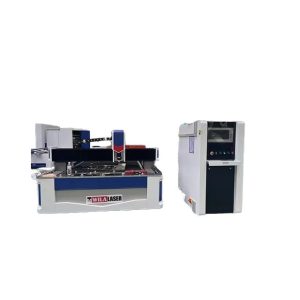
What a fiber laser actually gives you over other cutting methods
A fiber laser cutter concentrates a focused beam on the sheet and melts or vaporises
the material, with a coaxial gas jet clearing the kerf. Because there is no mechanical
contact and no hard tooling, the same machine cuts different shapes, materials and
thicknesses with nothing but a program change. That is the real economic argument: it
removes the tooling changeover that governs turret punch and shear-based blanking.
The four choices that decide your specification
1. Power class
Laser power sets the maximum thickness you can cut economically, and the speed at
which you cut thinner material. Two things are usually misjudged here. First, power
buys cutting speed on thin material far more than it buys thickness
capability — the relationship between power and maximum thickness is not
linear. Second, running a high-power source at low duty to cut thin sheet costs you
more per part than a correctly sized lower-power machine. Specify against your actual
thickness mix, not against the largest thickness you might one day see.
2. Bed size and loading
Bed size must match the standard sheet you buy. Loading method then divides machines
into two classes: manual loading, and exchange-table or automated loading. For a shop
running a single machine across mixed jobs, an exchange table is often the single
biggest throughput gain available — it removes the idle time while the finished
sheet is unloaded.
3. Assist gas strategy
Assist gas does two jobs: it clears molten material out of the kerf and it controls
the edge chemistry. From cheapest to most costly it runs roughly nitrogen, air,
oxygen — and each choice changes both the achievable edge quality and the
per-hour running cost. Gas selection is a cost decision as much as a quality decision,
and it should be settled before the machine is ordered, because it drives the nozzle
and gas-delivery configuration.
4. Nesting software and control
Material utilisation is where the money is. A nesting package that fills the sheet
properly typically beats a faster machine running bad nests. Look at how the software
handles common-line cutting, remnant management and automatic nesting across a job
queue — not just at whether it can import your file format.
Where these machines are used
- Sheet metal fabrication and subcontract cutting
- HVAC and ductwork components
- Electrical enclosures and panels
- Elevator and escalator components
- Food machinery and stainless fabrication
- Automotive and transport brackets
What we need to quote accurately
- Material mix and the thickness range for each material
- Maximum sheet size you need to process
- Typical and peak parts per shift
- Required edge quality — welded edge, painted edge, or visible finish
- Gas supply available on site
- Loading preference: manual, exchange table, or automated
- Existing CAD/CAM and file formats
Service and support
WILAMAC supplies installation and commissioning, operator training, spare parts and
ongoing technical support. Consumables — nozzles, protective lenses and filters
— are the day-to-day running cost of any laser, so confirm the local availability and
lead time of these before you commit to a machine, whichever supplier you choose.
Request a quote
Send us your material mix, sheet size and part volumes. We will specify the power
class, bed size and loading configuration that fits, and quote accordingly.
Two machine families, two different jobs
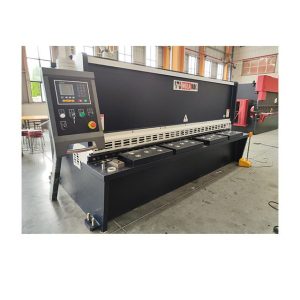
A hydraulic shearing machine holds a blade in a moving beam and drives it through the
sheet with hydraulic cylinders. That much is common to every shear. The choice that
actually decides your cut quality is which family you buy.
| Guillotine shear | Swing beam shear | |
|---|---|---|
| Blade path | Blade travels vertically; the cut is straight | Blade travels a curved arc |
| Rake angle | Lower, typically steeper adjustment range | Higher fixed-style rake |
| Cut edge | Cleaner, less distortion on narrow strips | Prone to bowing on narrow cuts |
| Narrow strip cutting | Good | Limited — the arc pushes the strip sideways |
| Typical use | Thicker plate, precise blanks, strip work | General sheet work, cost-sensitive shops |
| Machine cost | Higher | Lower |
If you cut a lot of narrow strips, or you are blanking parts that go straight into a
press brake, the guillotine is usually the correct answer. If you are cutting general
sheet to size, a swing beam machine does the same job for less money.
What determines the machine you need
Cutting length
The throat width sets the longest cut you can make in one stroke. It is the single
hardest specification to change later, so it is worth sizing for the widest sheet you
expect to handle in the next few years, not just today’s jobs.
Thickness capacity — and why it is always material-dependent
Shear force scales with the shear strength of the material, not with its thickness
alone. A machine rated for a given thickness in mild steel will not cut that same
thickness in stainless, which requires substantially more force. Always specify
thickness capacity together with the material. A rating quoted without a
material is not a specification.
Rake angle
The rake angle is the slight tilt of the blade that makes the cut progressive rather
than simultaneous across the full length. A larger rake reduces the peak force required
(predictable on thinner machines) but increases the tendency of the offcut to curl.
Adjustable rake lets you trade between the two.
Backgauge
The backgauge positions the sheet for repeat cuts. Its travel range determines the
widest strip you can set automatically, and its control type determines how repeatable
your production is. NC backgauges cover most job-shop work; CNC backgauges with
programmable stop sequences are what make short-run production economic.
Hold-down system
Hydraulic hold-downs clamp the sheet along the cut line before the blade descends.
Inadequate hold-down is the most common cause of a shear cutting a curved edge.
Blade material and edge geometry
Blades are consumables with a finite number of cuts between regrinds. Blade steel
grade and edge geometry should be chosen for your dominant material — the same blade
that lasts well in mild steel is the wrong choice for heavy stainless work.
Where these machines are used
- HVAC and ductwork fabrication
- Steel structure and fabrication shops
- Elevator and escalator panel production
- Electrical enclosures and switchgear cabinets
- Signage and architectural metalwork
- General job-shop sheet metal work
What we need to quote accurately
- Material type or mix (mild steel, stainless, aluminium, other)
- Maximum and typical thickness
- Maximum cut length required
- Narrowest strip you cut regularly
- Annual or monthly volume, and typical batch size
- Available power supply (voltage, phase)
- Whether you need NC or CNC backgauge programming
Send these and we will come back with a machine configuration, not a generic price list.
Service and support
WILAMAC machines are supplied with installation and commissioning support, operator
training, a spare parts channel and technical support for the life of the machine.
Because we also manufacture press brake tooling and accessories, consumables and wear
parts come from the same supplier as the machine.
Request a quote
Send us your cut list and material specification. Our engineering team will recommend
the shear family, cutting length and thickness capacity that fits the work, and quote
accordingly.

